Strota
Newsroom software manages stories. Nobody designed it for the reporters.
A story breaks at 7:42 PM. What we see is the news. What we don’t see is everything that happens before it. Newsroom systems today are built to manage content, not to support the people who produce it. Field reporters operate in unpredictable environments, using fragmented tools and informal support networks. Strota bridges this gap. It is a human-first newsroom operating system that captures early signals, preserves context, and structures chaos before publishing.
- RoleUX research, information architecture, UI for the bureau chief and the field reporter
- Year2025
- Duration12 weeks
- TeamTeam of 5
- ToolsFigma, FigJam, Google Forms, Google Meet
- DomainEditorial Tooling
Newsroom software starts at the desk. The story starts in the field.
- FieldWhatsApp, calls, memoryNo system
- DeskCMS
- PublishingWeb, print, TV
- AnalyticsDashboards
- No first signal
- Not built for chaos
- No escalation path
- No memory
- Feels like surveillance
3interviews
4empathy maps
- Field reporter
- Desk editor
- Bureau chief
- Senior beat reporter
“The weakest layer is field-to-bureau coordination, not publishing.”
Across all four, everyone…- Thinks about urgency
- Feels deadline pressure
- Sees fragmented tools
- Says “verify and send”
- Does coordination by hand
- Hears speed versus accuracy
Common painFragmented, and blind before publishing
Common gainClarity, without extra steps
Why do reporters stay on WhatsApp? Five whys down:
- Why 1Informal tools feel faster
- Why 2The system ignores field reality
- Why 3Fear of being replaced
- Why 4Built without asking reporters
- Why 5No say in the system
Root causePushed from the top down, never pulled from the bottom up. Strota had to be something reporters would choose.
4personas researched
2designed for, by me
- Designed for
Early-career field reporter
Clear escalation, and someone who knows where they are
- Designed for
Bureau chief
Who is free, and structured updates from the field
- Researched
Desk editor
Clean submissions and clear story ownership
- Researched
Senior beat reporter
Context from past stories, without micromanagement
- Designed for
Is this news?
Look it up
Make sense
Communicate
Reflect
MoodAnxiousPressuredClearerWaitingReliefPainWhen to escalate?
Slow checks
No past cases
Blind after filing
No feedback
FixFirst Signal
Voice to log
Similar stories
Live status
Edit compare
Each tool is good at its part. None is built for the reporter in the field.
Field-firstEscalationSafetyMemoryPublishingWhatsAppPartlyNoNoNoNoWolftech GoNot used or available in IndiaPartlyPartlyPartlyNoYesAP ENPSNoNoNoPartlyYesDalet, iNews, RossNoNoNoNoYesStrotaYesYesYesYesPartlyDoes it well Partly Not at all
- How might we · 1 of 10
…let reporters escalate urgent news in under 10 seconds, with no forms?
Must haveEasy to build →Must have · harder
- Voice to structured log
- Smart routing
- Escalation prompts
- Workload dashboard
Must have · easyBuilt first
- Ultra-fast First Signal
- Urgency tagging
- Story-bound chat
- Reporter availability
Good to have · harder
- “Last time this happened…”
- Similar story detection
Good to have · easy
- 30-second Smart Brief
- Colour-coded status
- Sensitive flag
Strota
Field reporter
First Signal
- Voice capture
- Urgency + beat
- Sensitive flag
Field Log
- Live updates
- Attachments
- Smart Brief
Draft & Filing
- Auto-draft
- Headline assist
- Send to CMS
Shared
Verification
- Tip-off check
- Cross-channel
- Duplicates
Safety
- Live location
- Check-ins
- Emergency
Memory
- Past cases
- Beat history
- Mentor notes
Bureau chief
Coordination
- Smart routing
- Escalations
- Workload
Analytics
- Clearance speed
- Bottlenecks
- Reach
Admin
- Roles
- Beats
- Routing rules
Process
- 01
Discover & interviews
3 weeksMapping how a story moves before publishing, then interviews with a desk editor, a bureau chief and a senior reporter.
- 02
Define
2 weeksFive whys, empathy maps, personas and journeys, narrowed to two people: the field reporter and the bureau chief.
- 03
Prioritise & structure
3 weeksCompetitors, a must-have matrix and the information architecture.
- 04
Design
4 weeksThe field reporter’s app and the bureau chief’s dashboard.
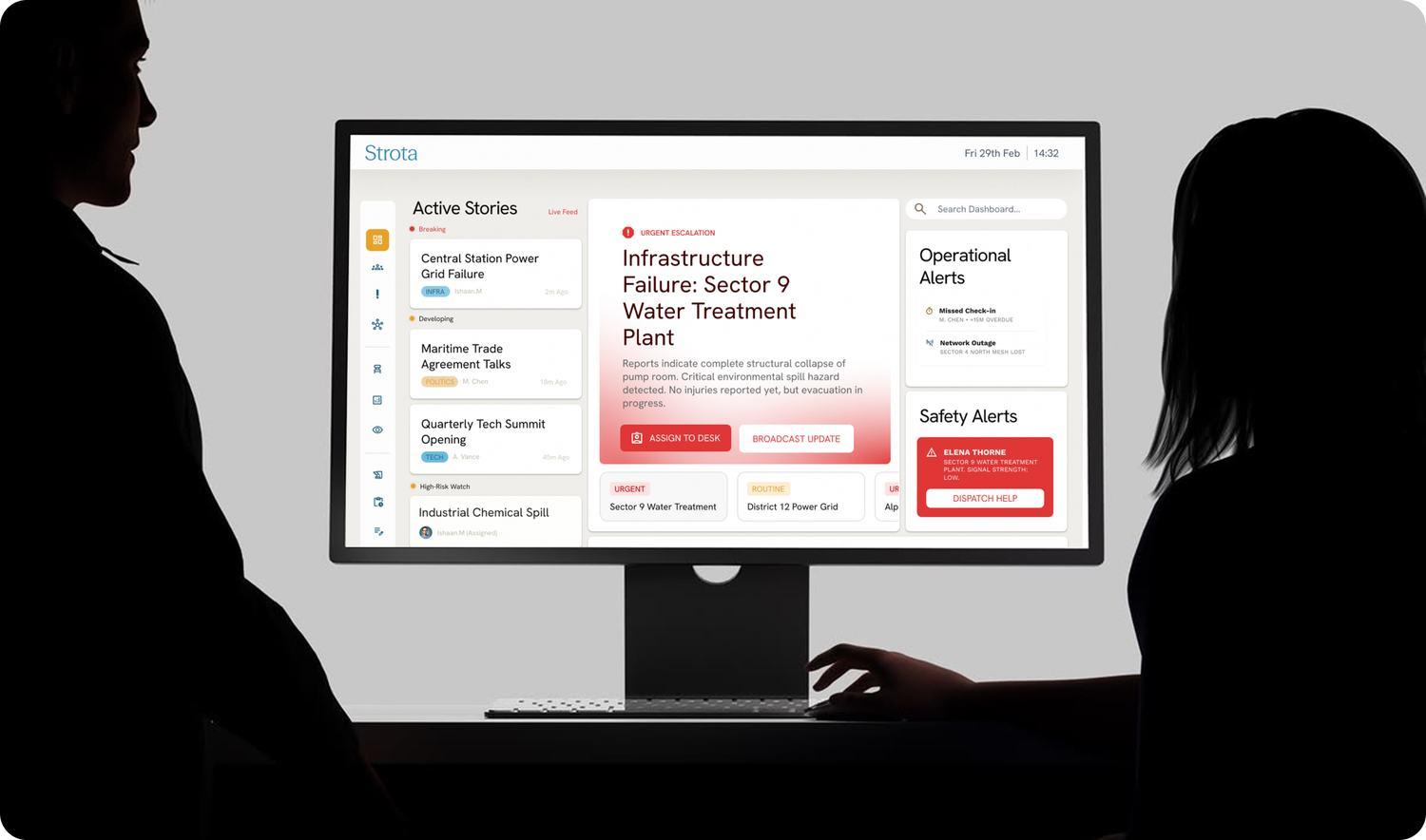
One screen for everything the bureau chief decides.
The command centre
Live stories down the left, the most urgent one in the middle, and anyone in danger on the right. Click a story, a button or the sidebar to move around.
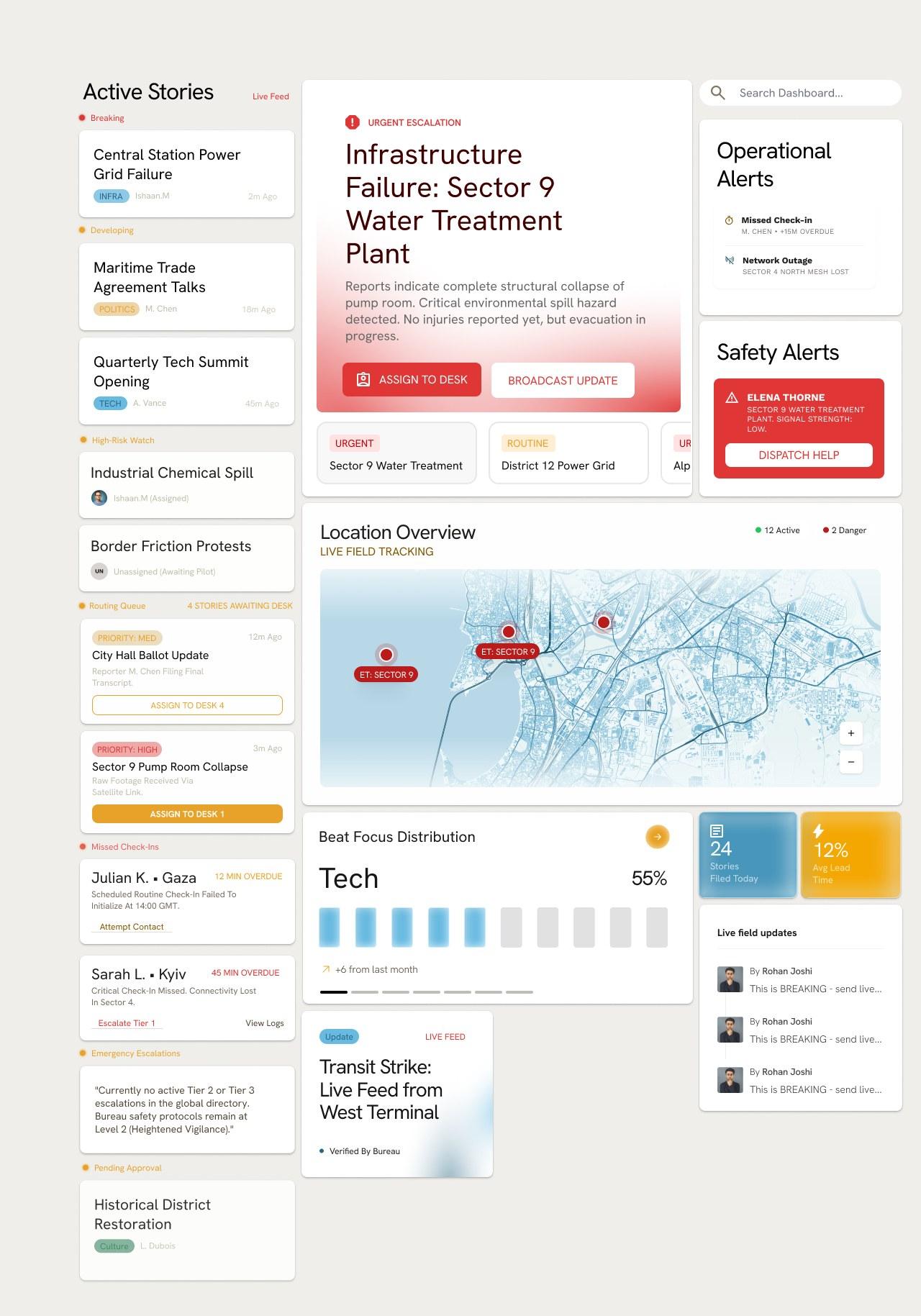



- Every live story, from breaking to awaiting approval
- The most urgent story first, with Assign and Broadcast a click away
- A reporter in danger, with Dispatch Help
- Where every reporter is, and where the danger is
- Stories waiting for a desk, assigned in one click
- Missed check-ins, flagged by how overdue they are
The app a reporter can use with one hand, on the move.
Start from the day’s assignments
Breaking assignments from the bureau, what’s happened to stories already filed, and which desks are free. Tap the screen, or the tab bar, to move around.

- Breaking assignments, sent by the bureau chief
- What’s happened to stories after filing
- Open stories, one tap away
- Which desks are free right now
Impact
Interviews showed reporters had no dedicated tool for the work before a story, so Strota became one.
- Most reporters coordinate over WhatsApp, Slack and Teams, with nothing built for the job.
- Strota brings that coordination into one system, with a separate view for each role.
What I learned
- 01
Design for where the work really happens.
The real coordination lives in chat threads, not in the newsroom’s software, so the product had to start there.
- 02
One story, many users.
Reporters, editors and bureau chiefs need different views of the same story.
- 03
Interviews moved the brief.
Talking to people in the field showed the gap wasn’t publishing; it was everything before it.