Apology Dynamics
Why does “sorry” mean something different depending on who says it?
Apologies are a basic human interaction for acknowledging wrongdoings and restoring relationships. Yet, saying sorry is heavily influenced by cultural norms and gender dynamics, often diluting the word’s true value. This research abandons standard surveys for a highly qualitative Cultural Probe Kit, investigating the hidden motivations and emotional aftermath of apologizing behavior among a localized cohort of 8 college-going students in Mumbai.
- Project nameThe Dynamics of Apology: Exploring Cultural and Gender Variations in a Mumbai College Cohort
- DomainBehavioral Research & Cultural Probes
- Year2025
- TeamArnav Chakravarty & Melvis Hilton
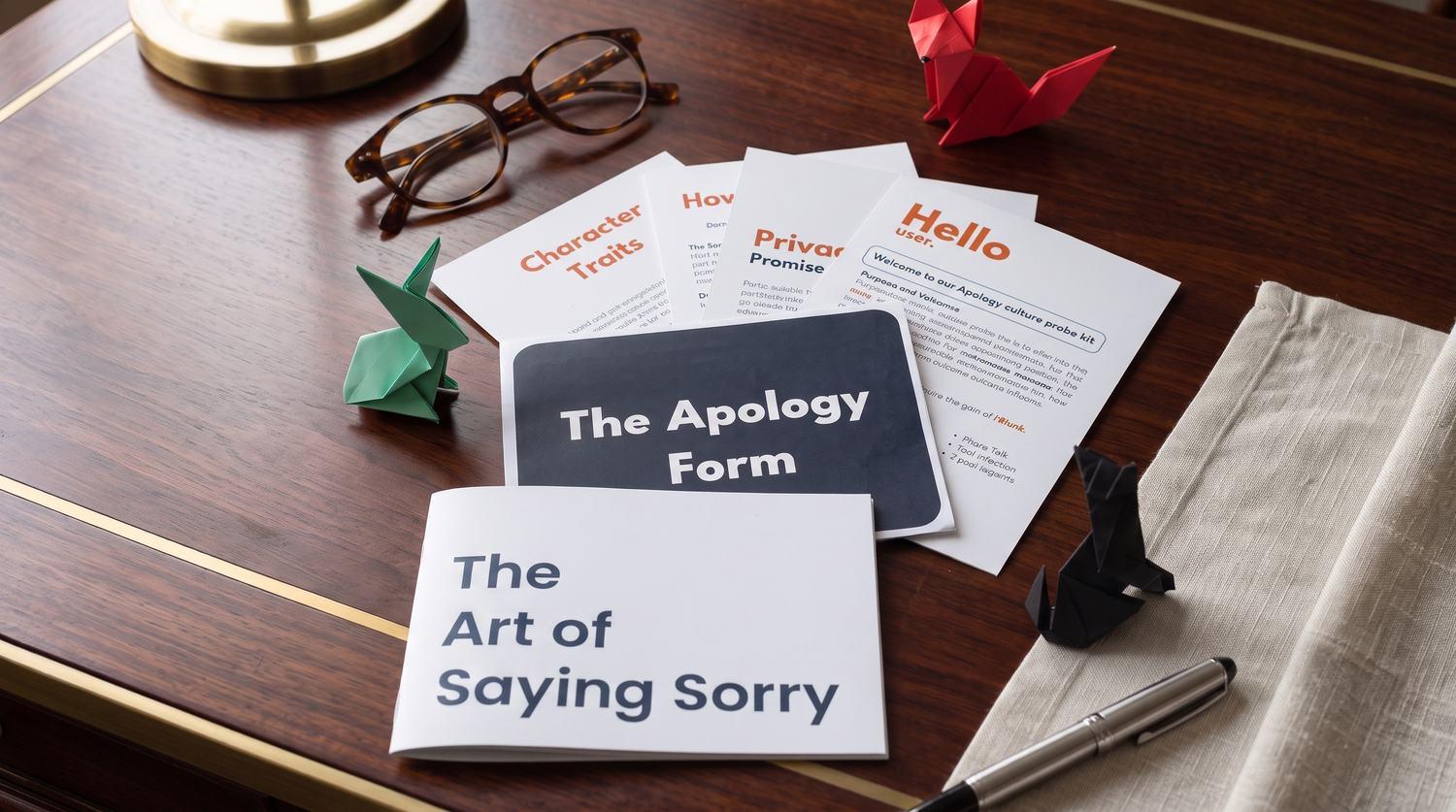
To navigate a highly emotional and circumstantial topic, we designed ‘The Apology Toolkit’, a 7-day cultural probe kit. We deployed this kit to 8 participants aged 19 to 20. By allowing participants to self-report in their own environments, we bypassed observational bias and captured highly authentic, qualitative data regarding their daily interactions.
Participants selected an origami character to represent their instinctive apology style. ‘Paws’ (Dog) represented apologizing out of ingrained habit, ‘Whiskers’ (Cat) represented conflict avoidance driven by cultural politeness, and ‘Flopsy’ (Rabbit) represented apologizing only when genuine harm is done. This revealed that apologies driven by cultural norms drastically inflate the frequency of the word, changing how individuals view themselves.
Using a daily Apology Form, we quantified these highly emotional behaviors. We discovered that the average person apologizes 9 to 10 times a day. However, participants reported actually meaning their apologies only 7 to 8 times a day. This proved a significant disconnect between frequency and sincerity, especially in public spaces where societal pressure outweighs genuine remorse.
The data highlighted stark gender contrasts: women apologized an average of 10 times a day, while men averaged 7 times. In private spaces, men and women apologized equally (averaging 5 times). However, in public spaces, women exhibited a significantly higher rate of apologies (3-4 times compared to men’s 1-2 times), highlighting the intense societal pressure women face to maintain social harmony.
Men primarily apologized due to direct emotional triggers like guilt or a sense of responsibility. Women frequently apologized due to cultural norms or habit, often feeling self-critical or accountable even when not at fault. Ironically, women also reported feeling a sense of ‘relief’ post-apology more often than men, confirming that for many, an apology is a tool to alleviate immediate social anxiety rather than to express genuine fault.